
Important Announcement and Impossible Tale #3, Part I
The Pearl, Part I: Impossible Tale #3
Dear Readers,
Before the story, I’ve an important announcement: I’m going professional!
That’s the positive spin on what I’m about to tell you. Substack stays in business by taking a small percentage of writers’ earnings — and therefore promotes the content of paid writers. The accounts of those writing for free (like me) get hidden by the algorithm, undiscoverable to thousands of potential readers. If I want to write for a growing audience, I must provide some paid content. THIS IS NOT AN APPEAL FOR YOU TO START PAYING. I must start charging for some things so the algorithm will promote my Substack — but you are free not to purchase them.
You are among my first 1,100 readers, and I’m grateful that you’ve invited me into your inbox. You can remain a free subscriber, continue to receive occasional travelogues and essays, and access the archive — or you can “upgrade” for $5/month or $50/year to receive all that AND read my short stories and access a monthly video Substack Chat with me in which we’ll discuss whatever YOU are reading. I’ll hold the Chat on the first Tuesday of each month at 7 p.m., starting on September 1st. I look forward to it! Thank you for supporting me as a free or paid subscriber as I continue to write. (If you are already a free subscriber, the “Subscribed” buttons should now say “Upgrade” — but don’t take that as an imperative.)
And now, “The Pearl, Part I.” At the end of this post, there will be a link to Part II if you would like to “Upgrade.”
August, 1348 — St. Bartholomew’s Eve
“I thank you, Prior John!” Jack Holland said as the priory bells rang the ninth hour, signaling his release from Latin studies. Jack returned his quill, pen knife, and ink pot to their box and stuffed his parchment scraps into his satchel, along with his wax tablet and stylus.
“Until Monday, Jack. Don’t forget the translation of the 23rd Psalm. And Jack—” Prior John said, stopping the boy’s headlong escape, “—try to put some poetry into it.”
“I will, sir, thank you!”
“Where are you headed?”
“Fishing on the Thames! I want to catch the tide while it’s out!”
“Ah! Bring me your finds, and we’ll see what we can identify. Are you coming to the Fair?”
“Wouldn’t miss it! See you tonight!”
Jack sprinted through the priory cloister, receiving an admonishing look from one of the Brothers, and slowed his pace through the adjoining nave of the church. The River Thames lay three quarters of a mile south of the Priory of St. Bartholomew, but Jack took a detour through the north transept door so he could see the merchants and priests setting up their booths for the Bartholomew Fair. The Priory’s annual cloth sale, which provided additional income for the ministry of the church, would open that night on St. Bartholomew’s Eve, and everyone was noisily at work. Carpenters erected tables while priests shouted orders and merchants carried their bolts of cloth through the North Gate onto the fairground that lay within the priory walls. The three-day fair was the greatest amusement Londoners saw all year, and not even fear of the encroaching plague could keep them from this beloved, two-hundred-year-old tradition.
Jack wondered if there would be tumblers as usual and fire eaters — and thought that surely a fire-eater could not die of the pestilence. The Great Mortality had crept across Europe for the past year and had somehow leapt over the Channel to southwest England. Rumor had reached the City at the end of June of the terrible illness that killed whole villages in Dorset. His brother Robert, a physician trained at Cambridge and the University of Paris, said that it was only a matter of time before the pestilence found its way to London and that they should pray for forgiveness and protection. The astrological charts portended disaster, and Robert had heard of no effective remedy.
With death looming, the Fair promised a much-needed distraction, and Jack would return that night for the opening festivities.
He skirted around two Brothers setting up the ticket table and ran out the West Gate onto Smythefeld. Heading south, he scooted down the narrow lane between the hospital wall and the priory wall, past the Anglo-Saxon church of St. Botolph-without-Aldersgate, through the open gate in the London City wall, past his own parish church of St. Agnes, and around the corner to his house. He opened the door, lifting his fishing bag from its hook on the wall with one hand while hanging up his Latin satchel with the other.
“Hallo, Mum!” Jack called down the low hallway to the back garden where his mother always prepared supper in the sunlight.
“Jack, is that you?” she called back.
“I’m going fishing, Mum! I’ll be back for supper!”
“Don’t get caught by the tide, Jack.”
“I won’t, Mum. See you later!”
Jack ran a few houses down to the Taylors’ home where he rapped on the door. A girl about his age answered and smiled at her friend. She saw his bag and said, “Off to fish, are you, Jack?”
“I am, Caty! Is Hugh here? Does he want to come?”
The tailor’s wife came to the door with a baby on her hip. “Hugh heard your knock and went to find his pattens. He’ll be down —”
“I’m here!” Hugh said, his protective footwear in hand. “Let’s go!”
“Keep an eye on him, please, Jack. Don’t let him fall. And watch the tides! Be home before supper!”
“Yes, Goodwife Taylor!”
“Mum, I don’t need watching!” Hugh said with confidence, following his friend.
Jack began a brisk walk down the dirty street, giving Hugh a friendly shove now and then to help him avoid piles of horse manure and night soil. Moving this slowly was a sacrifice for Jack, aching to catch the tide on its way out, but his friend Hugh had never been able to see well, near or far. He couldn’t run without tripping and embarrassing himself, and Jack wouldn’t make him feel like a cripple even if he missed the tide.
“Will there be a good foreshore? Will we fish upstream of the bridge?” At 15 years of age, Hugh was three years older than Jack. But his infirmity had narrowed his world and made him youthful.
“Yes, we should have a couple hours before the tide comes back. Let’s go to our favorite spot!”
The boys wended their way south, navigating through the market on Westchep, its merchants selling the last of the day’s wares, with Hugh grasping the back of Jack’s tunic. A dog looking for scraps dashed between their legs, and urchins on the same mission lurked near the merchants’ tables, watchful for anything that dropped. The boys kept a hand on the purses at their belts and pressed through the market.
They continued south on Bredstrete where Jack said, “Do you want a bun? This baker is selling an overbaked batch for cheap.”
Hugh reached for a farthing, and Jack said, “I’ll buy them, don’t bother. He’s practically giving them away.”
They ate their buns as they turned east on Fishstrete, which stank of its wares, and continued over a makeshift bridge that got them over the filthy Walbrook with dry feet. Finally, they turned south again and passed through the seediest part of the City. At this stage, everything leaned toward the Thames — the warehouses, the bakehouses, the tenements — and the streets, dry after no rain for a week, turned to mud as they confused themselves with the river.
Jack and Hugh sat on a tenement stoop, out of the way of the bustling fishwives and rivermen, and put on their pattens. These thick wooden clogs strapped over their shoes and raised them above the mud, preserving their footwear, as well as their mothers’ sanity when they returned home. With his fishing satchel slung across his body, Jack led the way between shacks and warehouses, down to the muddy foreshore of the Thames.
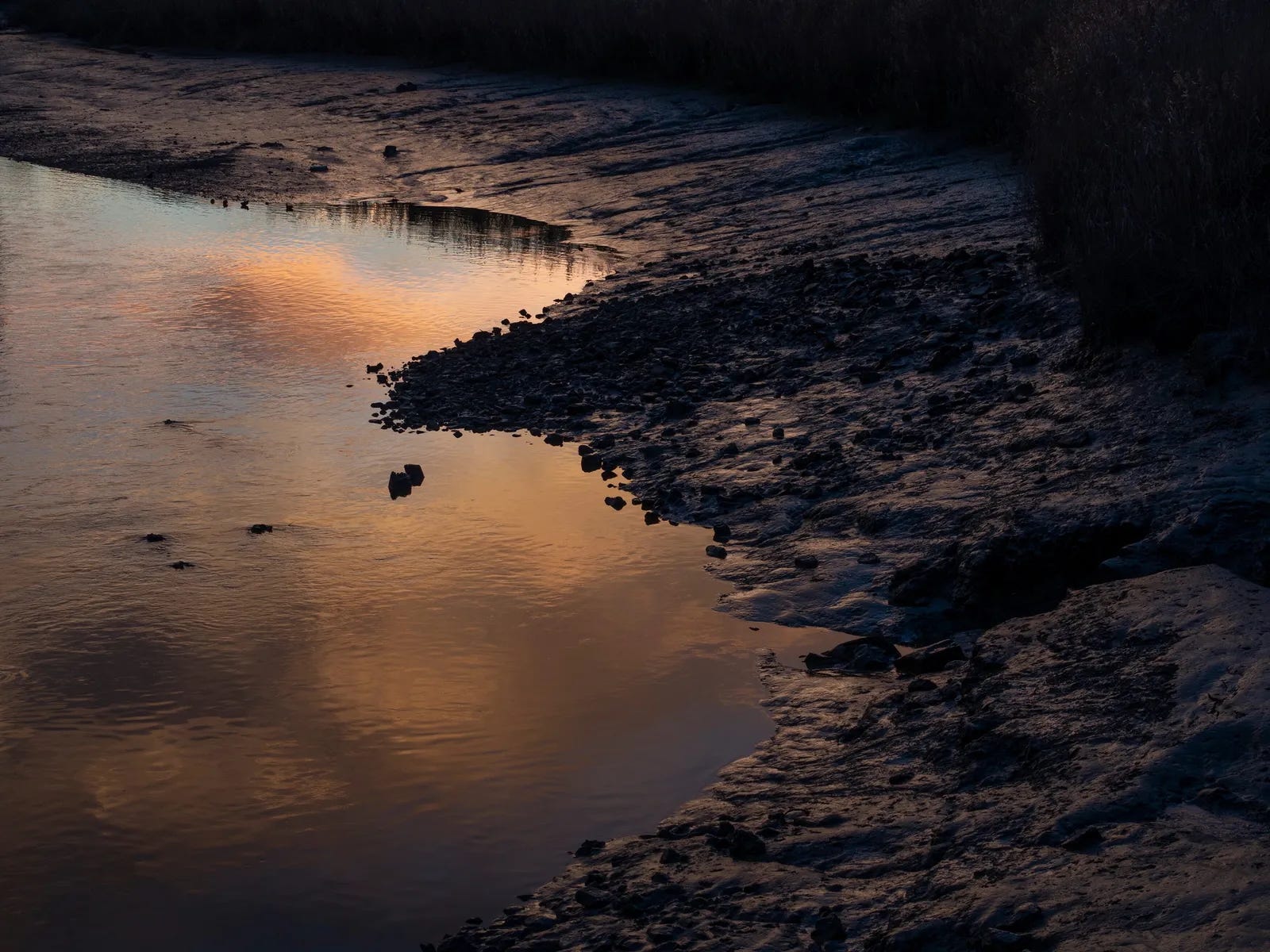
The River Thames in London is a tidal river that ebbs and flows with the ocean to which it runs. Low tide exposes the riverbed’s outside edges, rich with the remains of the discarded or lost over centuries.
Mostly, it’s trash, many said to Jack. What can you do with broken pottery? Of what use is a twisted nail? Why would you care about the bent blade of an old dagger?
But to Jack, these finds spoke of worlds that existed centuries before him, full of people who spoke the Latin language he laboured over during the day as he prepared to be a physician like his brother. There were things in that mud that came from places far beyond England. Jack had found a statuette of a household god, brought by some ancient person from barbaric regions; a tiny, oval, translucent stone bearing the etched image of a woman — the goddess Athena, Prior John had told him — that had probably been lost from a ring; several glass beads of various sizes and colours from bracelets broken long ago; an ax head wrought with Nordic runes, probably dropped by a Viking as he waded ashore to attack; and silver coins displaying the heads of Caesars.
These last had obvious value if melted down — but Jack would never sell his collection. There was something profound to him about finding evidence of all those long-dead people — their striving to make beautiful things, to have purpose, to make sense of this chaotic world. Collecting ancient people’s stories was what everyone understood Jack did when he went ‘fishing.’
Jack looked to his left toward the nearby London Bridge, which he could hear and smell from where he stood far below at water level. Nearly a town unto itself, the houses, shops, carts, horses and innumerable humans made a racket as they jostled for room on the only bridge over the Thames. Things were still being lost or dumped into the river every day, he thought as he saw a woman pour the contents of her chamber pot from a third-story window into the middle of the water and witnessed an altercation on the north end closest to him. The fight ended with a satchel falling to the foreshore below where a group of urchins rushed to take what could be traded for their daily bread.
Jack thanked God for the thousandth time that his father had left them a house and that his brother’s income as a physician was more than sufficient for their needs. The boys haggled over the contents of the satchel while the owner yelled at them from far above. These boys often searched for valuable items near London Bridge and could be seen in all weathers in the same threadbare, castoff clothing, looking for anything that could be sold. About his age, they were all smaller than Jack, undernourished with haunted, furtive eyes. Now he wished he’d purchased all the overbaked buns and brought them here for these forgotten boys. Without his mother and brother, he would be one of them.
Hugh also faced the bridge where he could sense the activity.
“What do you see, Hugh?” Jack asked.
“Just a fuzzy, grey stripe across the light. That’s the bridge, of course.”
“Yes,” Jack said and described to him the details that Hugh couldn’t see, a habit he’d picked up as a child when he discovered that his friend’s world was a blur. When he’d gotten Hugh to laugh over his description of a rowboat stuck against one of the piers of the bridge, he turned his attention to the riverbed at his feet.
Hugh sat on the footing of an ancient pier and gazed at the light around him as he listened to his friend.
“Here’s a little something. It’s just a broken piece of pottery, but you can feel how different it is from the way it’s made today,” he said, handing Hugh the fragment before returning to his search. “Here’s a smooth stone. Not smoothed by the river — you can tell it’s been purposely shaped. It’s another gaming piece like the ones Prior John identified.”
“We’ve found lots of these,” Hugh said, feeling the stone. “The Romans loved their gambling.”
“You’re right,” Jack said as he shifted the grit around with the toe of his patten. “Think how they cast lots for the clothes of Christ.” He took a trowel out of his bag and bent down to scrape around an unusual shape. “Look at this, Hugh. It’s a — a hairpin, maybe? Or a huge needle?” He handed it to Hugh who felt its thin shaft and tested its strength without breaking it.
“Not metal. Bone? Ivory?”
“Something like that. It’s pretty stained by the river, but I think it’s Roman. Let’s ask Prior John at the Fair. In the daylight tomorrow.”
Hugh placed it next to the gaming piece and the bit of pottery. When he looked up, he could see the dark shapes of people on the foreshore nearby. “Jack….”
Jack looked up into the hostile eyes of six or seven scrawny boys, wearing the spoils of their recent windfall. The largest child had wrested a fine cloak from the smaller boys, the latter end of which dragged in the mud. Another boy wore a rich man’s tunic that gathered at his feet. A third had the leather satchel itself slung over his shoulder with the corner of a book peeking out of it. Jack eyed that book, knowing the great value the owner must have placed on it. He would tread carefully. These gangs of malnourished scavengers could become violent in their desperate search for food.
Thank you for being among my most faithful readers! If you’d like to continue the story and read more in this series, please “Upgrade” below, and click on Part II.

I love these tales so much! And it looks like I’ll need to be making some decisions for my own platform here soon…I’m excited for more readers to discover your gifts and talents, Kate!