
Mining Truth
Romans, Welsh Gold Mines, The Princess and the Goblin, and Other Legends
Readers,
I said you wouldn’t hear from me for a while — and then an experience in Wales made me think. This essay is the result.
Now I will get back to researching the medieval novel and writing the Jane Austen sequel.
Hope you’re having a wonderful summer, and Happy 250th to America!!!
There’s a medieval Welsh legend I first heard on my recent trip to Wales. One version tells the story of five saintly brothers — Gwyn, Gwynno, Gwynoro, Ceitho, and Celynin. (I’ll be curious to hear how the AI voiceover handles those names.)
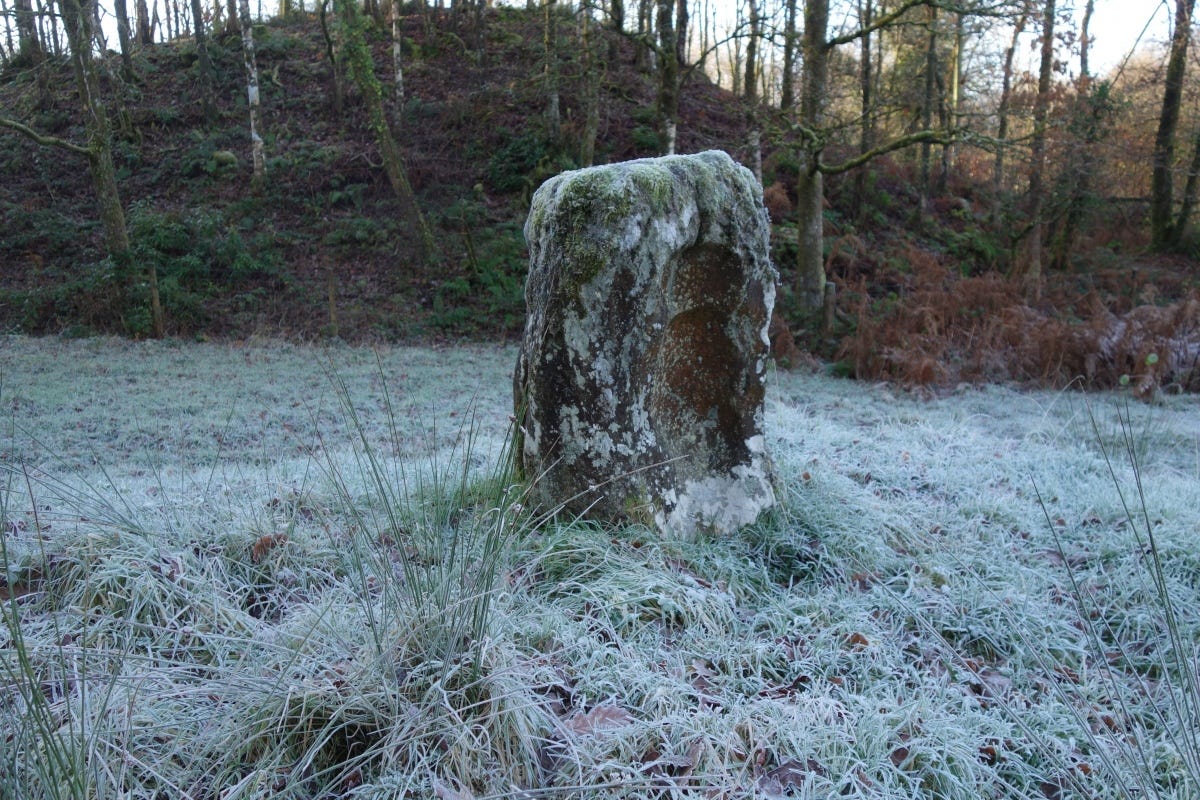
The five brothers were hated for their sanctity by an evil sorcerer who lived in the ancient, abandoned mines of Ogofau. One day when the brothers neared the Ogofau, the sorcerer sent a hailstorm of such intensity that they were forced to take refuge against a nearby ancient standing stone. So great was the violence of the storm that their heads left impressions in the rock they gathered round. Having successfully snared the saintly brothers, the sorcerer condemned them to an enchanted sleep and stole them away, deep into the mines, where they will sleep until King Arthur returns.
Stories like this inspire wonder in me because they reach for answers to our most fundamental human questions: Why do bad things happen to good people? Is there life after death? Who is responsible for my downfall? Who will rescue me? Legends are exciting because they connect us to completely different people over the expanse of centuries as they address our common fears and hopes.
Collecting millennia-old stories is exciting, but imagine my joy (and my family’s endurance) when I stumbled upon the very source of this legend on a visit to an ancient Welsh mine, the Ogofau — ‘caves’ on the Dolaucothi Estate in Mid-Wales. I had just dragged my husband and daughter on a lengthy and vertical walk to view the gorgeous scenery surrounding the mines when, nearly back to civilization, the ancient standing stone came into view. The Carreg Pumsaint, ‘Stone of the Five Saints,’ stands in a clearing exactly as described in the legend with unusual rounded impressions on several sides of the stone as if men had crouched there. Archaeologists have since excavated many nut-sized pieces of quartz from the surrounding soil, the same quartz found in the mines from which gold dust would have been extracted by beating it. Perhaps this beating of the quartz caused the head-shaped hollows on the standing stone in earlier eras. Imaginative archaeologists hypothesize that these rocks scattered around the Carreg Pumsaint gave rise to the legendary hail. I didn’t stop to take a picture of the Carreg Pumsaint because photographing a rock would have been the final insult to my exhausted family. This one from the internet will have to do.
From a placard in the treeline, I learned that the labyrinthian mines within the hills were the ominous dwelling of the legend’s sorcerer — who, perhaps, was credited with the deaths of many an early explorer of those caves. The Ogofau have intrigued the Welsh for time out of mind. Brave pre-Roman Celts must have found ore there because the Romans heard the rumors and marched troops across the island to mine the Ogofau for themselves in the first century, AD. 19th century archaeological finds and 20th century carbon dating have confirmed that the Romans were responsible for the shafts there, later mined by the Victorians and again by 20th century miners between the wars. Even more interesting to me, the Romans created an astonishing, rectangular tunnel in the hill, carved by hand through the solid rock 2,000 years ago that no one has mined since.
In our age of electric, motion-activated lights and safety regulations, my family’s self-guided tour of the Roman’s rectangular tunnel could have been a boring walk. On the contrary, I found it fascinating. Standing at the opening to that tunnel, I sensed the telescopic nature of time that drew me into kinship with the Roman soldiers who had created that place nearly two millennia earlier. The distance of time collapsed as I saw them far from home in this cold and damp region, the farthest western outpost of the Roman empire. They had different gods than we and different experiences of the world, of course, but from an altered point of view, they were just like us. Their questions were the same as mine: How is the child I’ve left at home, thousands of miles away? Will my mother recover from the terrible illness she had when I last heard from her? What if I get sick in this foreign place?
As I walked through the tunnel with my family, I considered the Romans’ questions and concerns, as present as their pickaxe marks clearly visible on the walls, unchanged by the passage of centuries. These men probably answered their questions with stories and myths passed down from civilizations lost to time, just as the medieval Welsh invented their legends.
Given that the Legend of the Five Saints arose from the juxtaposition of the mysterious mines and the sparkling hail-sized rocks surrounding a pitted standing stone, I wonder what the medieval Welsh imagination thought of the Roman tunnel. In an era when sorcerers represented the dangers of this fractured world — and mythical beasts gave rise to the symbol of Wales, the dragon — a medieval Welshman might have taken a rest on his climb over that hill….
Winded by the incline, Ewan takes a drink from his wineskin and leans against a stone cliffside thick with vines and fern — only to stumble backwards and fall to the ground! He fights through the vegetation and finds himself standing in the mouth of a dark cave. A dried branch at his feet will make a sturdy torch, so he strikes his flint — and gasps as he beholds the abandoned hall of an ancient Mountain King.
He has seen many caves in his life with their jagged ceilings reaching down to brain the careless man. On his arm he bears a twisted scar from an unexpected outcropping of rock that tore his flesh when he was young. And he has seen caves with ceilings high as a church. But a cave like this he has never before witnessed. The smooth, upright walls on each side extend far into the darkness ahead. And overhead — flat and level as the walls, the roof must have been cut by goblins, who are known for their skill underground, as well as their riches.
Alone, he knows that now is not the time to venture into this domain. He will return to his village and tell his brothers — they will come back together to explore where the tunnel leads…..
Discoveries such as this must have inspired many tales handed down to us, embellished and allegorized like the Legend of the Five Saints, each tale making sense of our uncontrollable and mysterious world. This past year, I read a modern fantasy tale to my young nieces, The Princess and the Goblin by George MacDonald. A Victorian writer of complex and imaginative Christian symbolism, MacDonald’s work was a model for J.R.R. Tolkien’s own Christian tale, The Lord of the Rings. During our reading of The Princess and the Goblin, my nieces were entranced by the ordeals that the young miner named Curdie endured in the depths of the king’s mines. During the course of the story — in which he foils the nasty goblins’ plot to kidnap the princess and force her into marriage with the goblin prince — Curdie becomes lost in the labyrinthian interior. While spying on the goblins, he is imprisoned behind a wall of rocks with no hope of escape, and he experiences the complete darkness of the earth where no sun- or moonlight has ever penetrated.
As I read, my nieces usually enjoy illustrating the story, but on this occasion as the danger increased, they both paused, markers suspended, riveted by the quiet horror of being lost in the dark. The seven-year-old suddenly leapt to her feet asking, “How will Curdie get out? Will his father find him?” The ten-year-old knew the answer was coming and said, “Shhh! Listen!” A few chapters later, relief dawned on their faces when help came to Curdie. (I wouldn’t spoil it for the world, but I’ll give you a “clew:” there was still no light. “We walk by faith and not by sight.”)
We’ve recently begun The Princess and Curdie, MacDonald’s sequel to the earlier fairy tale. It picks up the story a few years after Curdie’s triumph, after he has decided to remain with his parents as a miner instead of accompanying the grateful king to his court. In the sequel, Curdie’s help will be needed by the king again, but early in the story, Curdie and his father have followed an unfamiliar light far into the mine, to depths they didn’t know existed. They follow the light into a cathedral-like space, carved out by the floods millennia ago and then made passable on foot again when the water receded. My nieces’ eyes sparkled as I read to them about the flashing gems in the rock walls, fit for a king’s crown, that seemed to illuminate the room. The light that Curdie and his father followed brightens and resolves into a magnificent woman, younger than spring and older than the mountain. The light emanates from her. When she leaves the cavern, the darkness is absolute. When she returns, the gem-encrusted wall coruscates with spectacular color.
Moved to wonder, my seven-year-old niece asked, “Is that true? Does the light come from the lady?”
She always asks excellent questions. Is it true? In the story, it is true. In general, it is not true that light radiates from magical women. I decided that the seven-year-old was mature enough to hear a complicated answer.
“It’s true in a special way,” I said. “Fairy tales tell stories that are not possible in real life. But they tell us about things that are true.”
She gazed past me, processing that information.
I continued, “You asked me if this were true because you could tell that something about this story is true. Do you know what it is?”
She knew in her heart but couldn’t quite explain it yet.
Her ten-year-old sister said, “It’s telling us about God. The Bible says that light comes from God.” She is discerning beyond her years.
“That’s right,” I said, “the story is telling us that hope and light and truth are real and that they come from a Person. In real life, that Person is Jesus, not a magical lady — and the story is telling us to look for hope and rescue from that Person.”
The seven-year-old was satisfied that the story was true like she thought, and we resumed the reading.
We are now only a few chapters into the sequel and had to interrupt our progress for summer travels. I’m excited to continue the story this fall — now more than ever because of my experience in the Welsh mines.
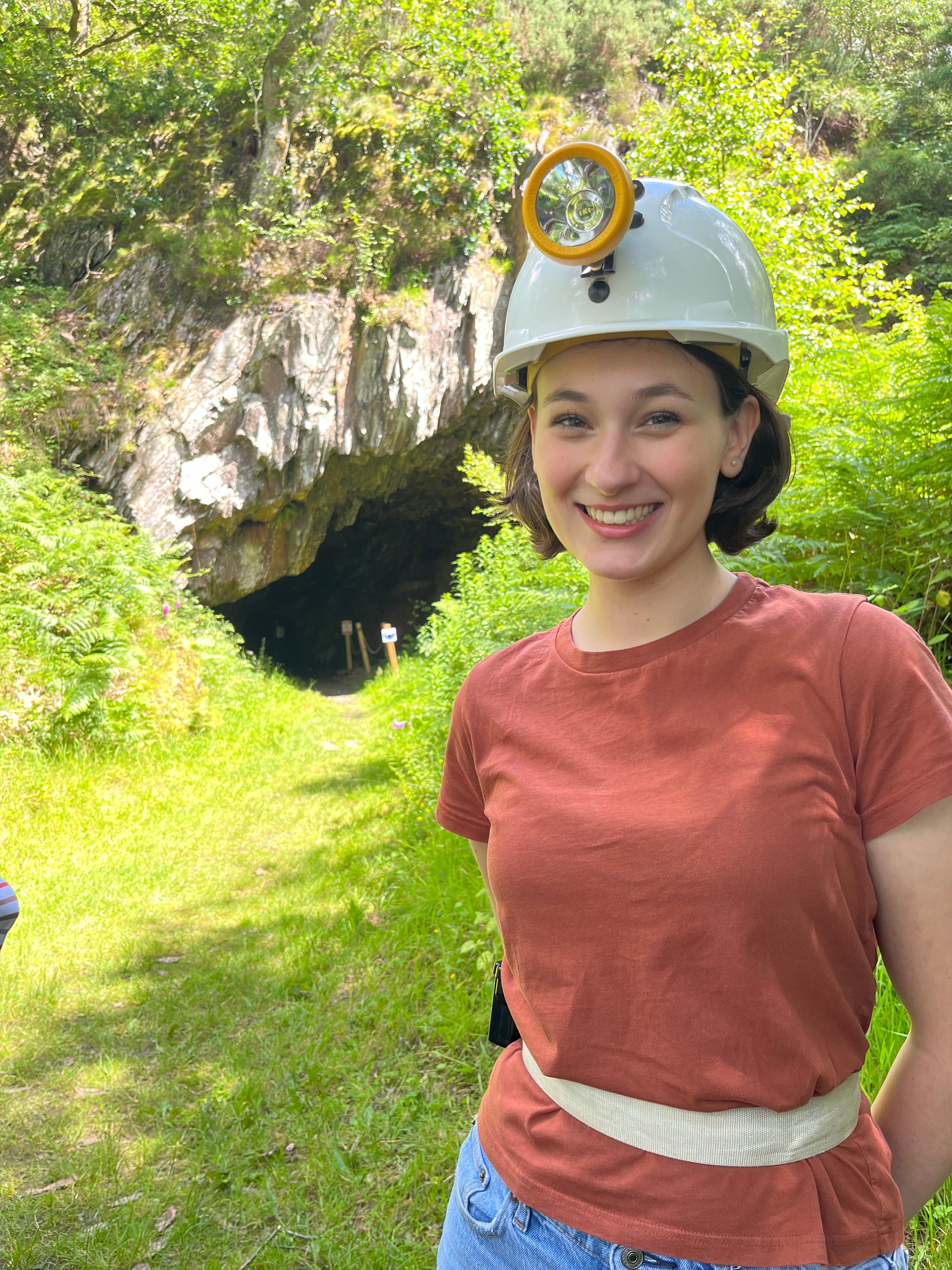
On our guided group tour of the caves mined by the Romans, Victorians, and 20th century miners, I saw the conditions Curdie experienced each day as he worked. Entered through a massive opening in the side of the mountain, the path descended and branched off, turning and growing narrower and lower before opening into a room the size of a cottage, formed by water ages ago. The water that flows through hidden streams in the mountains dripped from the ceilings and ran in a rivulet at our feet. The ceiling dropped unexpectedly in places where we slammed our hard hats into craggy protrusions and knocked ourselves into the rough walls as we crouched and shuffled through the narrow passages. Our battery-powered headlamps threw light wherever we turned and revealed a shimmering silver fungus creeping along the rock face. At one point, our guide told us to cover our electronic watches, put away our cameras and phones, and turn off our headlamps so we could see the mine as the Romans and Victorians had known it.
The blackness was complete. Eyes wide, we stared into the darkness and could see nothing, not even our hands in front of our faces. After a few moments of listening to the drips and the internal streams deep in the mountain, the guide struck a match and lit a candle. The flame illuminated our smiling faces, secure in the knowledge that we could have been saved at any point by the tap of a flashlight icon. But for a few imaginative moments, I had been left in the dark with the 10-year-old Victorian boys who had separated the rough, gold-laden stones by feel from the smooth, useless rocks, while their elders took the candles and pressed deeper into the Ogofau. I had been with Curdie, trapped in the goblin’s cave, lost forever, as he thought. That absolute darkness, frightening as it must have been without hope of a light, is the allegory that stands for something much scarier: the human condition, dead apart from the light of hope.
The people walking in darkness
have seen a great light;
on those living in the land of deep darkness
a light has dawned.
Isaiah 9:2
As the tour ended, the guide gave us some parting instructions for getting down the hill safely, and then a little boy, who had been totally silent throughout the whole tour, burst with an urgent question that overcame his shyness.
“Who put the gold in the mine?” he asked.
The tour guide stared at him, confounded by the question.
“Who put the gold in the mine?” the boy asked him again.
The adults smiled at each other over his head, some uncomfortable with the potential answers, others surprised by the profundity of the question.
Clearly, we were all waiting for his parents to respond to his curiosity, shared by every human since the beginning of time: Who made this world? How did all of this happen? Is that Person gone? Is that Person still doing things? Does that Person care? Does that Person care about me?
The question, Who put the gold in the mine? still hung in the air when the tour guide finally broke and said, “Nature!”
One of the other adults said, “Coincidence!”
My 16-year-old daughter grimaced at me in disbelief at these answers and gestured for me to chime in — and then the moment passed. The parents had turned the child toward the stairs carved into the hill, and the little boy started counting them aloud as he descended, his curiosity sated for the moment by ‘Nature’ and ‘Coincidence.’
As we passed the tour guide, my husband said to him, “Interesting that our hearts believe that someone put the gold there.”
“I’m sorry?” he said, deaf to the implication.
“Thank you for the tour,” my husband said. “It was great.”
“You’re welcome!”
That little boy’s question and the unsatisfying answers he received bothered me for the rest of the day. I thought about it during dinner. I ruminated over it as we drove back to our rental cottage. I considered it as my daughter and I worked on a puzzle that evening. If his parents didn’t believe in God the Creator, there had to be a better answer than “Nature” or “Coincidence.” Coincidence is much harder to believe in than a Person. After all, the boy didn’t ask How did the gold get in the mine? He asked, Who put the gold in the mine? He knew better than to imagine a confluence of random events. He knew that someone had caused the gold to be there. I concluded that it would have been better to say, “The Mountain King.”
Perhaps, in the grand tradition of humans creating tales to explain how and why things are as they are, the little boy hoped to hear that an all-powerful ruler of the mountain — who enjoyed creating colorful gems and yellow gold — painted the mountain’s interior with splendor. Perhaps he wanted to hear of the Mountain King’s anger when someone stole the gold and put it to evil use — how the mountain would quake and the lightning would strike. And maybe the little boy hoped that the Mountain King still existed — that he enjoyed the boy’s visit and guided him safely through the mine without injury — that the king is benevolent and generous with his subjects. Such a story would have answered his question.
And it would have been true.
I am so envious! What an amazing experience to explore the mines. I'd never heard of the tale of the brothers and am excited to explore that a little more! I've never been to Wales (I hope to one day, my dad's paternal side is essentially Welsh and nothing else) but the country has always been synonymous with magic and whimsy to me. The story of the boy asking who put the gold in the mine was so moving albeit heartbreaking. I like to believe he continued the conversation with his parents and it planted seeds for further Truth seeking.
Great article. There are some lands that seem to almost be intrinsically linked to myths and legends. The combination of time, geography, and culture weave a spell of mystery over them. Europe, especially England, Scotland, Wales, and Ireland, seem to have many places like this. Here in the United States, it being so much younger, it doesn't seem to have that same air of native mystery. The closest I can think of are Washington Irving's Dutch tales and folklore of the haunted New York countryside.